Industrial
Hydrogen Embrittlement in High-Strength Fasteners: What Buyers Need to Know and What to Demand from Suppliers
High-strength fasteners can fail catastrophically hours, days, or months after installation, with no warning at receiving inspection and no indication of a problem until the joint separates in service. The cause is often hydrogen embrittlement, and the failure mechanism is completely invisible until it happens. A grade 8 bolt that passes every dimensional check, every material verification, and every mechanical test at the supplier can still fail brittly in the field if the manufacturing process introduced hydrogen into the steel and didn't remove it correctly.
Prevention starts at the supplier's manufacturing process, not at the OEM's receiving dock. There is no practical inspection method at the buyer's facility that catches embrittled fasteners before they fail. The only reliable defense is specifying the right process discipline, verifying it was followed, and requiring the documentation to prove it.
This is a practical breakdown of what hydrogen embrittlement actually is, which fasteners are at risk, how it's prevented, and what documentation sophisticated buyers should demand from their suppliers.
What Hydrogen Embrittlement Actually Is
Hydrogen embrittlement is a failure mechanism in high-strength steel where hydrogen atoms diffuse into the metal's atomic lattice and cause delayed brittle cracking under sustained tensile stress. The mechanism sounds abstract but the field consequences are anything but.
Hydrogen atoms are the smallest of all elements. They can slip into the spaces between iron atoms in the steel microstructure without disrupting the crystal structure. Once inside the metal, hydrogen migrates over time toward areas of stress concentration: thread roots, head-to-shank transitions, and any location where the local stress is elevated. As hydrogen accumulates at these concentration points, it reduces the local ductility of the steel and initiates microscopic cracks. Under continued load, those cracks grow until the fastener fractures.
The critical word is "delayed." Hydrogen embrittlement doesn't cause immediate failure. A fastener installed on Monday can fail on Friday, or three weeks later, or six months later. Failure timing depends on the amount of hydrogen present, the applied preload, the ambient temperature, and the specific microstructure of the steel. This is what makes hydrogen embrittlement so dangerous: standard receiving inspection catches nothing, mechanical testing at the supplier passes, and the failure appears without warning in service.
Which Fasteners Are Susceptible
Susceptibility to hydrogen embrittlement scales with steel strength and hardness. The general rule: fasteners with tensile strength above approximately 145 ksi (roughly SAE Grade 8 and above, or hardness above 32 HRC) are at meaningful risk. Lower-strength fasteners are essentially immune because their microstructure isn't strong enough to sustain the tensile stress needed for hydrogen-induced cracking.
The specific fastener grades at risk:
- Carbon and low-alloy steel: SAE Grade 8 and Grade 8.2, ISO Property Class 10.9 and 12.9. These are the most commonly encountered susceptible grades in general industrial applications.
- Alloy steel: 4140, 4340, 8640, and A574 socket head cap screws in their typical quenched-and-tempered condition (32-38 HRC or higher). These are workhorse aerospace and heavy industrial materials.
- Precipitation-hardened stainless: 17-4 PH at H900 or H1025 conditions, 17-7 PH, 15-5 PH. All are at risk when heat-treated to high-strength conditions.
- Martensitic stainless: 410 and 416 in the hardened condition.
- High-strength aerospace alloys: A286, Custom 465, and similar precipitation-hardened materials at high-strength temper conditions.
Lower-strength materials (SAE Grade 2, Grade 5, austenitic stainless 304 and 316) are not at practical risk of hydrogen embrittlement in normal service. For a complete breakdown of fastener materials and their applications, see our complete guide to fastener materials.
How Hydrogen Gets Into the Fastener
Hydrogen enters susceptible fasteners through three main paths:
Manufacturing processing. Acid pickling, used to clean steel surfaces before plating or coating operations, generates atomic hydrogen at the steel surface. Even brief acid exposure can introduce enough hydrogen to embrittle a high-strength fastener. Poorly controlled cleaning processes are a common but often overlooked source.
Electroplating processes. This is the largest and most well-documented risk. Every electroplating process involves an electrolytic reaction at the substrate surface, and that reaction generates atomic hydrogen. Zinc electroplating, zinc-nickel electroplating, cadmium plating (historically common, now phased out for most applications), chrome plating, and copper strikes all introduce hydrogen into the base metal during the plating cycle.
Service environment. Cathodic protection systems, active corrosion in the field, and some chemical exposures can also generate hydrogen at the fastener surface. This mechanism is more relevant to oil and gas, chemical processing, and marine applications than to typical industrial equipment.
The first two categories are what buyers can control through specification. If a high-strength fastener requires an electroplated coating, hydrogen embrittlement risk is created during manufacturing and must be addressed before shipment. The specification that requires the coating implicitly requires the mitigation process, whether or not the buyer explicitly writes it into the print.
How Hydrogen Is Removed (Baking / Hydrogen Relief)
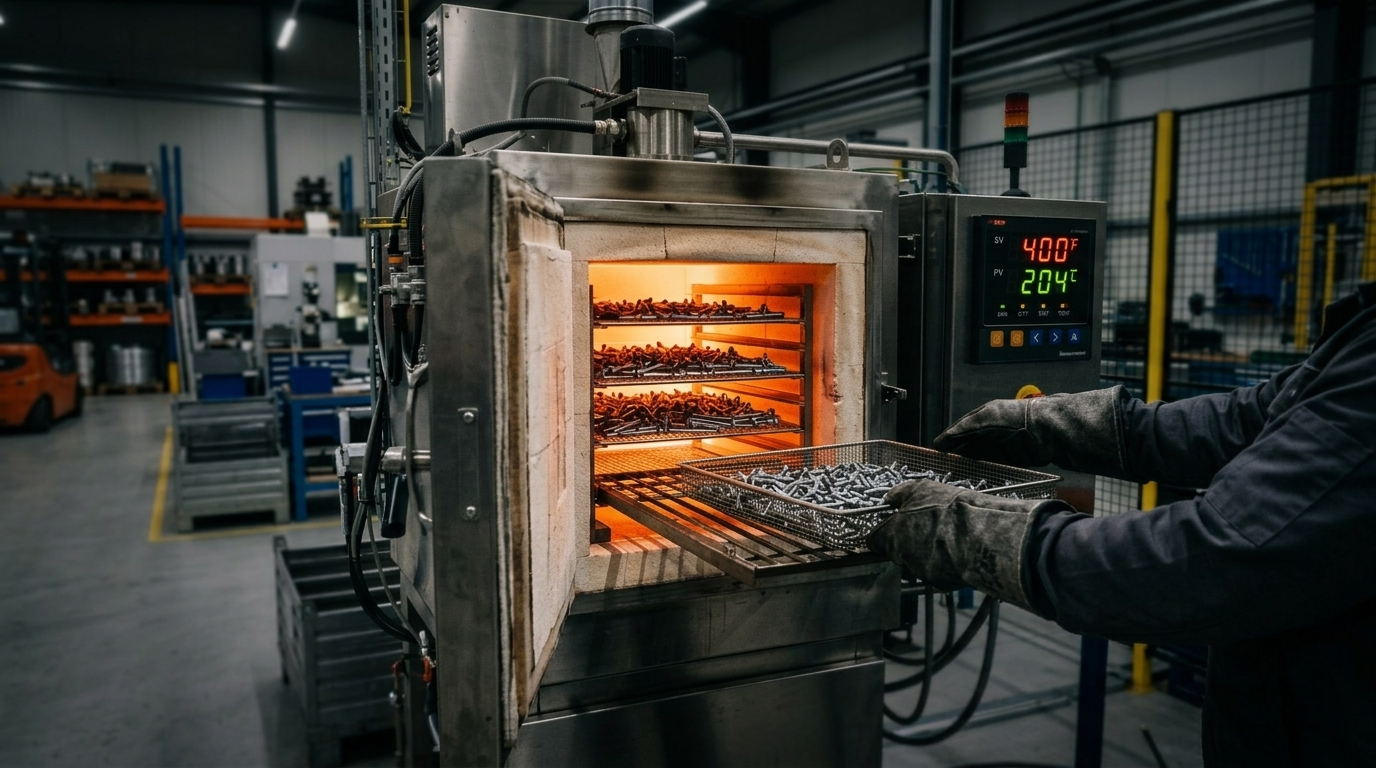
The prevention method is thermal baking after plating. Elevated temperature increases hydrogen diffusion rate, allowing hydrogen to migrate out of the steel and escape at the surface before it can concentrate at stress points and cause cracking. Done correctly, baking removes enough hydrogen to make the fastener functionally equivalent to a non-embrittled part. Done incorrectly, baking accomplishes nothing.
Four process parameters determine whether baking actually works:
Timing. Baking must begin within a specific window after plating, typically 1 to 4 hours per ASTM B850, though some specifications allow up to 8 hours. If a plated fastener sits at ambient temperature for longer than this window, hydrogen becomes locked into stable trapping sites in the microstructure. Baking after this point cannot remove hydrogen from those sites, and the fastener remains embrittled even after a full baking cycle. This is why timing discipline matters so much.
Temperature. Baking temperature is typically 375-425°F (190-220°C). Lower temperatures don't drive hydrogen diffusion fast enough. Higher temperatures risk tempering the base metal and reducing mechanical properties.
Duration. Baking duration ranges from 4 hours (minimum for smaller, thinner parts) to 24+ hours (for larger, more heavily-plated parts, or higher-strength grades). Duration depends on part geometry, coating thickness, and material susceptibility.
Verification. Post-baking testing per ASTM F519 (mechanical hydrogen embrittlement test) or ISO 15330 (preloading test) provides sample verification that the process actually removed hydrogen. Verification testing is destructive but sample-based, and provides evidence the process works.
Suppliers who understand these parameters treat them as non-negotiable. Suppliers who don't understand them cut corners, and the corners they cut don't show up at the buyer's receiving dock.
What Documentation Buyers Should Demand
Sophisticated procurement teams sourcing high-strength fasteners require specific documentation to prove hydrogen embrittlement prevention was handled correctly. Anything less means accepting risk that can't be verified after the fact.
The documentation package should include:
- Written baking process specification. The supplier should provide their documented process, including target baking temperature, duration, and timing requirements from plating completion. If the supplier can't produce this document, they don't have a controlled process.
- Time-stamped baking furnace logs for the specific lot. Not a general statement that "baking was performed," but time-stamped records showing when the specific lot was baked, at what temperature, and for how long. Time stamps allow verification that baking began within the required window after plating.
- Verification testing records per ASTM F519 or ISO 15330. Sample testing confirming the process actually removed hydrogen. Should be documented on a lot-basis or frequency-basis with statistical relevance.
- Complete traceability chain. From mill certification through plating through baking through shipment. Every step documented, every date stamped.
- Written statement of process compliance with the applicable specification. The supplier should attest that the specific lot was processed to ASTM B850, ISO 4042, or whatever standard the print calls out.
A supplier who resists providing time-stamped baking logs is telling the buyer something important. The information is either not available (which means the process isn't controlled), or the supplier considers it proprietary (which means the buyer has no way to verify claims). Both are red flags on high-strength fastener sourcing.
For a detailed look at how documentation callouts should be written on a fastener print, including inspection and traceability requirements, see our guide to reading a custom fastener print.
Coatings That Avoid the Risk Entirely
For high-strength fastener applications where hydrogen embrittlement risk is unacceptable, several coating processes avoid the risk entirely by eliminating the electroplating step.
- Mechanical galvanizing. Peening process deposits zinc powder onto the part surface using glass beads in a tumbler. No electroplating, no acid cleaning, no hydrogen introduction. Corrosion performance comparable to electroplated zinc at similar thickness.
- Hot-dip galvanizing. Thermal immersion in molten zinc. No plating chemistry involved. However, the elevated temperature of the galvanizing bath can affect the heat treatment of high-strength grades, making HDG inappropriate for some Grade 8 and higher applications.
- Xylan and PTFE-based coatings. Thermally cured fluoropolymer systems applied over prepared surfaces without acid cleaning or plating. Compatible with any strength grade.
- Geomet and zinc-flake systems. Thermally cured zinc-aluminum flake coatings in inorganic binders. No plating, no acid, no hydrogen. Increasingly common in automotive OEM specifications for high-strength fasteners.
For applications where any hydrogen embrittlement risk is unacceptable (aerospace primary structure, safety-critical automotive, life-support medical), these coating processes are often specified regardless of cost. For a full comparison of coating options, see our comparison of fastener coating options.
How ZOAG Handles Hydrogen Embrittlement
ZOAG manufactures custom per-print fasteners for industrial OEMs, including high-strength applications where hydrogen embrittlement prevention is essential. Coating and material specifications on the print determine the process discipline required from manufacturing partners. Documentation on high-strength fastener lots includes the process records specified by the print, including baking documentation where applicable.
Standard lead time is approximately 120 days from quote approval. ZOAG's sourcing footprint is global, with production placed wherever makes the most sense for the specification, timeline, and tariff position.
If you have a high-strength fastener application with hydrogen embrittlement risk considerations, request a quote with your drawings and process requirements.
Frequently Asked Questions
What is hydrogen embrittlement in fasteners?
Hydrogen embrittlement is a failure mechanism where hydrogen atoms diffuse into high-strength steel and cause delayed brittle cracking under tensile stress. The failure is invisible at inspection, occurs hours to months after installation, and can cause catastrophic joint separation without warning. It affects primarily high-strength fasteners (SAE Grade 8 and above, or hardness above 32 HRC).
Which fastener grades are at risk of hydrogen embrittlement?
Fasteners at meaningful risk include SAE Grade 8 and 8.2, ISO Property Class 10.9 and 12.9, alloy steel grades (4140, 4340, A574) at typical quenched-and-tempered hardness, precipitation-hardened stainless (17-4 PH, 17-7 PH), martensitic stainless in hardened condition, and high-strength aerospace alloys. Lower-strength grades (SAE Grade 2, Grade 5, austenitic 304 and 316 stainless) are not at practical risk.
Why does the baking window (1-4 hours) matter?
If a plated fastener sits at ambient temperature longer than the specified window (typically 1-4 hours per ASTM B850) before baking, hydrogen becomes locked into stable trapping sites in the microstructure. Baking after this point cannot remove hydrogen from those sites, and the fastener remains embrittled even after a full baking cycle. This is why time-stamped baking furnace logs matter for verification.
What documentation should I require from my supplier for high-strength fasteners?
Require: written baking process specification, time-stamped baking furnace logs for the specific lot, verification testing records per ASTM F519 or ISO 15330, complete traceability from mill certification through baking to shipment, and written attestation of process compliance with ASTM B850, ISO 4042, or the applicable standard. A supplier who resists providing time-stamped baking logs cannot verify the process was controlled.
Which coatings avoid hydrogen embrittlement risk?
Coatings that avoid the risk include mechanical galvanizing (peening process, no electroplating), hot-dip galvanizing (thermal process, but limited to non-heat-sensitive grades), Xylan and PTFE-based coatings (thermally cured, no plating chemistry), and Geomet or other zinc-flake systems (thermally cured, no acid cleaning). Electroplated coatings (zinc, zinc-nickel, cadmium, chrome) all introduce hydrogen and require proper baking to mitigate.
Sources
- ASTM F1940, Standard Test Method for Process Control Verification to Prevent Hydrogen Embrittlement
- ASTM F519, Standard Test Method for Mechanical Hydrogen Embrittlement Evaluation of Plating/Coating Processes and Service Environments
- ASTM B850, Standard Guide for Post-Coating Treatments of Steel for Reducing the Risk of Hydrogen Embrittlement
- ISO 15330, Fasteners: Preloading Test for the Detection of Hydrogen Embrittlement
- ISO 4042, Fasteners: Electroplated Coating Systems
- SAE J429, Mechanical and Material Requirements for Externally Threaded Fasteners
- FED-STD-H28 series, Federal Standard for Screw-Thread Standards for Federal Services