Industrial
The Complete Guide to Fastener Materials: Carbon Steel, Stainless, Alloy, and Specialty Alloys for OEM Buyers
Material selection is where fastener performance actually gets determined. Every mechanical property that matters (strength, ductility, corrosion resistance, temperature tolerance, fatigue life, and cost) depends on the material specified on the print. Buyers who specify "steel" without further definition end up with parts that work most of the time and fail some of the time. Buyers who specify material to the correct grade, temper, and heat treatment get parts that behave predictably.
The challenge for procurement is that the material landscape is wider than most buyers realize. Carbon steel comes in eight commonly specified grades. Stainless steel has three distinct metallurgical families and dozens of alloys within each. Alloy steels, precipitation-hardened stainless, superalloys, titanium, and aluminum each solve different problems. The right material for a specific fastener depends on the application, and the wrong material undermines every other decision on the print.
This is a practical breakdown of the fastener materials commonly specified on industrial prints, what each one delivers, and where each one belongs.
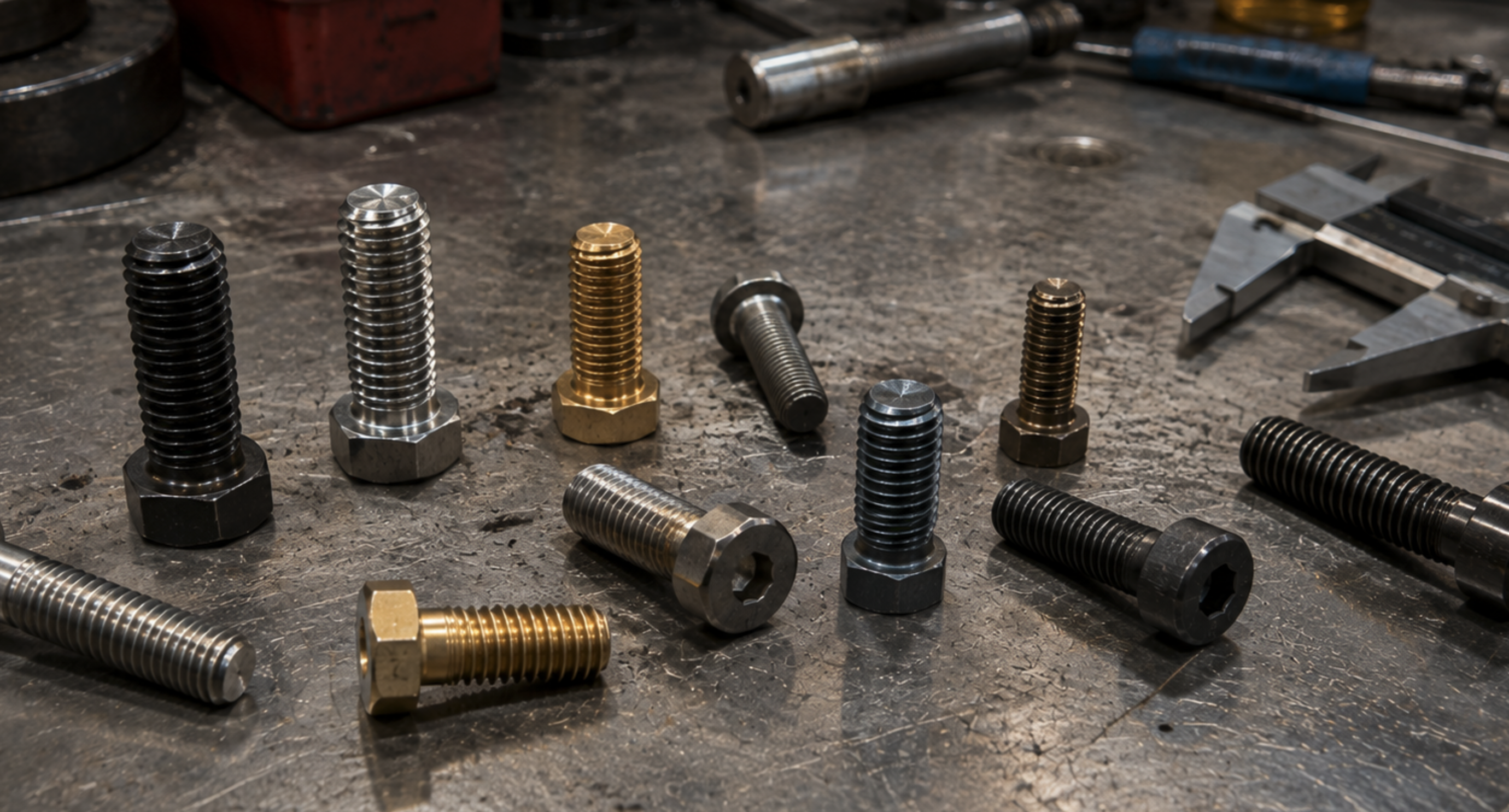
Why Material Matters More Than Most Buyers Realize
Two fasteners that look identical can have completely different mechanical properties depending on their material. A grade 2 steel bolt and a grade 8 steel bolt are the same size, thread, and finish. Their tensile strengths differ by more than double. Their yield strengths differ by nearly triple. In a joint designed for grade 8 preload, substituting a grade 2 bolt produces immediate failure under service loads.
Material also determines corrosion behavior, temperature tolerance, ductility, and fatigue life. A carbon steel bolt survives dry indoor environments but corrodes in humidity. A 304 stainless bolt handles most industrial applications but pits in chloride environments. A 316 stainless bolt tolerates marine conditions but softens at elevated temperatures. Each choice trades off against the others.
The point is that material specification is engineering, not shopping. Sophisticated procurement teams treat material grade with the same rigor they treat dimensional tolerances. "Or equivalent" language on a fastener print gives the supplier permission to substitute a different material, which changes joint behavior in ways that don't show up until the assembly is in service.
Carbon Steel Grades
Carbon steel is the workhorse material for the majority of industrial fasteners. It's inexpensive, well-understood, easy to manufacture, and available in a wide range of strength grades. The tradeoff is corrosion resistance, which requires coating to achieve.
SAE J429 defines the standard grades of carbon and alloy steel fasteners in the United States. The grades that matter most for procurement:
- Grade 2: low-carbon steel, minimum tensile strength 74 ksi, yield strength 55 ksi. General-purpose applications with modest strength requirements. Common in construction hardware and non-critical assembly.
- Grade 5: medium-carbon steel, quenched and tempered, minimum tensile strength 120 ksi, yield strength 92 ksi. Standard for automotive, machinery, and general industrial applications where higher strength is required.
- Grade 8: medium-carbon alloy steel, quenched and tempered, minimum tensile strength 150 ksi, yield strength 130 ksi. High-strength applications including heavy machinery, structural connections, and safety-critical joints.
- Grade 8.2: identical mechanical properties to grade 8 but produced from a low-carbon boron steel alloy. Used where grade 8 is specified but boron chemistry is preferred.
The metric equivalents follow ISO 898-1 property classes: 4.6, 5.8, 8.8, 10.9, and 12.9. Property class 8.8 is roughly equivalent to SAE grade 5. Property class 10.9 is roughly equivalent to grade 8. Property class 12.9 is a step higher than either.
Carbon steel fasteners require coating for corrosion protection. The coating specification interacts with the strength grade because grades 8 and above are susceptible to hydrogen embrittlement when electroplated. Coating and material specifications should be evaluated together, not separately. For a detailed look at coating options and hydrogen embrittlement risk, see our comparison of fastener coating options.
Alloy Steel
Alloy steel expands the property envelope of carbon steel by adding chromium, molybdenum, nickel, and other elements. The result is higher strength, better fatigue resistance, and improved response to heat treatment.
The alloy steels most commonly specified for fasteners:
- AISI 4140: chromium-molybdenum steel with excellent strength-to-weight and good machinability. Common in shoulder bolts, high-strength studs, and applications requiring both strength and toughness. Typically quenched and tempered to 32 to 38 HRC.
- AISI 4340: chromium-nickel-molybdenum steel with even higher strength than 4140. Used in aerospace-adjacent applications and heavy structural connections.
- AISI 8640: nickel-chromium-molybdenum steel with good hardenability. Used in applications requiring uniform properties in larger cross-sections.
- ASTM A574: the standard specification for alloy steel socket head cap screws. Not a single alloy but a specification that covers 4037, 4140, 4137, and similar alloy steels heat-treated to specified strength ranges.
Alloy steel selection depends on the specific application. 4140 is the default workhorse for most heavy industrial applications. 4340 and 8640 are specified when 4140's properties are insufficient. All three require heat treatment to develop their full mechanical properties, and the heat treatment specification (Q&T to a specific HRC range) matters as much as the alloy designation.
Austenitic Stainless Steel (300 Series)
Austenitic stainless is the most common stainless family for industrial fasteners. It provides good corrosion resistance, ductility, and formability at moderate strength levels. The tradeoff is cost (higher than carbon steel) and mechanical strength (lower than heat-treated alloy steel).
The grades that matter for procurement:
- 302 (A1): general-purpose austenitic stainless, less common in modern fastener specifications
- 304 (A2): the workhorse of stainless fasteners. 18% chromium, 8% nickel. Excellent corrosion resistance in most industrial environments. Standard for indoor, food-contact, and general-purpose applications
- 316 (A4): 16% chromium, 10% nickel, 2% molybdenum. The molybdenum addition dramatically improves resistance to chlorides and marine environments. Standard for coastal, marine, chemical processing, and any application where 304 is insufficient
- 321: 304 stabilized with titanium to prevent intergranular corrosion after welding or high-temperature service. Common in exhaust and elevated-temperature applications
- 347: similar to 321 but stabilized with niobium instead of titanium. Alternative for high-temperature applications
The A2 and A4 designations come from ISO 3506 and are the metric-equivalent specifications for stainless fasteners. A2-70 or A4-70 designations combine the material grade with a strength property class (70 = 700 MPa tensile strength).
Austenitic stainless requires passivation after machining or welding to restore the chromium oxide passive layer that provides corrosion resistance. Passivation is a chemical treatment, not a coating, and it doesn't upgrade the base material's corrosion resistance.
Martensitic and Ferritic Stainless (400 Series)
The 400 series stainless steels trade some corrosion resistance for higher hardness and strength. They're less commonly specified than 300 series stainless but fill specific application niches.
- 410 (martensitic): hardenable stainless, minimum tensile strength 70 ksi (annealed) up to 195 ksi (hardened). Used in cutlery, valve parts, and specialty fasteners requiring hardness. Corrosion resistance is limited compared to 304
- 416 (martensitic): free-machining version of 410 with added sulfur. Used where machinability matters more than corrosion resistance
- 430 (ferritic): low-chromium stainless (16-18% Cr), lower corrosion resistance than 300 series but less expensive. Used in decorative and interior applications
The 400 series is not commonly specified for high-corrosion applications. When the environment is aggressive, 300 series or precipitation-hardened stainless is usually the better choice.
Precipitation-Hardened Stainless
Precipitation-hardened (PH) stainless combines the corrosion resistance of stainless with the strength of heat-treated alloy steel. It's a critical material family for high-performance applications where both properties matter.
- 17-4 PH (AISI 630): the most common PH stainless. Chromium, nickel, and copper with precipitation-hardened by copper. Excellent strength (up to 150 ksi tensile), good corrosion resistance, moderate cost. Used in aerospace, chemical processing, and industrial applications requiring both properties
- 17-7 PH (AISI 631): similar to 17-4 but uses aluminum for hardening. Used in aerospace springs and structural applications
- A286 (UNS S66286): iron-nickel-chromium alloy with titanium hardening. Handles elevated temperatures (up to 1300°F) while retaining strength. Common in aerospace turbine assemblies and high-temperature fasteners
- 15-5 PH: modified 17-4 with improved transverse ductility. Used in aerospace forgings and fasteners
Precipitation-hardened stainless is specified where 300 series stainless is insufficient in strength and alloy steel is insufficient in corrosion resistance. Cost is meaningfully higher than either alternative, so PH stainless is specified for applications where the combination of properties is required.
Specialty Alloys and Superalloys
For applications where standard stainless and alloy steels fail, specialty alloys fill the gap. These materials are expensive but irreplaceable in their application envelopes.
- Inconel 600, 625, 718: nickel-chromium-based superalloys with exceptional strength at elevated temperatures (up to 2000°F for some grades) and excellent corrosion resistance in aggressive chemical environments. Used in aerospace turbine hardware, chemical processing, and oil and gas
- Hastelloy (B, C-276, X): nickel-molybdenum-based alloys for aggressive chemical resistance, particularly to reducing acids and chloride-induced corrosion. Common in chemical processing plants
- Monel 400, K-500: nickel-copper alloys with excellent seawater corrosion resistance. Used in marine, desalination, and chemical processing applications
- MP35N: nickel-cobalt-chromium-molybdenum multiphase alloy with exceptional strength, corrosion resistance, and fatigue life. Used in medical, aerospace, and high-performance applications
Specialty alloy fasteners are specified when the application environment (temperature, chemistry, mechanical loading) exceeds what any standard material can handle. Cost is 10 to 100 times higher than carbon steel per unit, but the alternative is field failure.
Titanium and Titanium Alloys
Titanium delivers excellent strength-to-weight, exceptional corrosion resistance, and good high-temperature performance. It's expensive but essential in weight-critical applications.
- Grade 2 (commercially pure): unalloyed titanium, moderate strength (50-60 ksi tensile), excellent corrosion resistance, good ductility. Used in chemical processing, marine, and medical applications
- Grade 5 (Ti-6Al-4V): the workhorse titanium alloy. 6% aluminum, 4% vanadium. High strength (up to 130 ksi tensile), excellent fatigue life, corrosion resistance. Standard for aerospace fasteners and high-performance industrial applications
- Grade 7 (Ti-0.15Pd): grade 2 with palladium addition for enhanced corrosion resistance in reducing environments
- Grade 23 (Ti-6Al-4V ELI): extra-low interstitial version of grade 5. Used in medical implants and cryogenic applications
Titanium fasteners are specified in aerospace, medical, marine, and chemical processing applications where weight, corrosion resistance, or biocompatibility justify the cost. Cost is 5 to 10 times higher than stainless steel per unit.
Aluminum Fasteners
Aluminum fasteners are specified in weight-critical applications where the strength of steel is unnecessary. Cost is comparable to stainless steel, but strength is significantly lower.
- 2024-T4: aluminum-copper alloy, minimum tensile strength 62 ksi. Used in aerospace secondary structure and general aerospace-adjacent applications
- 7075-T6: aluminum-zinc alloy with the highest strength of common aluminum alloys, minimum tensile strength 82 ksi. Used in aerospace primary structure fasteners
- 6061-T6: general-purpose aluminum alloy with good corrosion resistance and moderate strength. Used in marine and general industrial applications
Aluminum fasteners have significantly lower strength than steel and are susceptible to galvanic corrosion when contacting stainless or steel components. Material selection needs to account for the entire joint, not just the fastener.
The Material Selection Framework
Every material on this list belongs in some applications and is wrong for others. The right material for a specific fastener depends on answering five questions before the print is finalized.
First, what strength does the joint require? Grades 2 through 5 for standard applications, grade 8 and above for high-strength requirements, specialty alloys for extreme cases.
Second, what's the environmental exposure? Indoor dry environments accept carbon steel with basic coating. Coastal and marine environments require 316 or better. Chemical processing environments require specialty alloys.
Third, what's the temperature range? Standard steel and stainless handle typical industrial temperatures. Elevated temperatures (above 500°F) require alloy steel or precipitation-hardened stainless. Extreme temperatures (above 1000°F) require Inconel or A286.
Fourth, does the joint require corrosion resistance in the joint itself, or just around it? A stainless fastener in a carbon steel joint creates a galvanic couple that accelerates corrosion of the steel. Material selection needs to account for interactions with adjacent components.
Fifth, does the application have industry-specific requirements? Aerospace applications require AS9100-compliant materials with full traceability. Automotive applications require IATF 16949-compliant materials. Medical applications require biocompatibility. Nuclear applications require ASME BPVC compliance. Industry certifications drive material selection as much as engineering requirements.
Buyers who answer these five questions before specifying a material end up with parts that perform. Buyers who default to "steel" or "stainless" without asking the questions end up with field failures they could have prevented at the print stage.
For a detailed look at how material specifications should be written on a print, including grade designations, heat treatment callouts, and mechanical property requirements, see our guide to reading a custom fastener print.
How ZOAG Handles Material Specifications
ZOAG manufactures custom per-print fasteners for industrial OEMs across a wide range of material specifications. Every material callout on the print is manufactured to specification, verified with mill certifications, and documented on the certificate of conformance accompanying each lot. Heat treatment is verified against the specified hardness range. Material substitutions are not made without written buyer approval.
Standard lead time is approximately 120 days from quote approval. ZOAG's sourcing footprint is global, with production placed wherever makes the most sense for the specification, timeline, and tariff position.
If you have a print with a specific material specification you want reviewed and quoted, request a quote.
Frequently Asked Questions
What's the difference between SAE grade 5 and grade 8 bolts?
Grade 5 is medium-carbon steel quenched and tempered to 120 ksi minimum tensile strength and 92 ksi yield. Grade 8 is medium-carbon alloy steel quenched and tempered to 150 ksi tensile and 130 ksi yield. Grade 8 provides 25% higher tensile and 40% higher yield strength but at higher cost and greater hydrogen embrittlement risk when electroplated.
What's the difference between 304 and 316 stainless steel?
Both are austenitic stainless steels with similar strength. The critical difference is molybdenum. 316 contains approximately 2% molybdenum, which dramatically improves resistance to chlorides and marine environments. 304 is adequate for most indoor and general industrial applications. 316 is required for coastal, marine, chemical, and de-icing salt exposure. 316 costs approximately 20 to 30% more than 304.
What are A2 and A4 stainless steel?
A2 and A4 are ISO 3506 designations for austenitic stainless fasteners. A2 corresponds approximately to 304 (18% chromium, 8% nickel). A4 corresponds approximately to 316 (with molybdenum addition). Common strength grades are 50, 70, and 80, referring to 500, 700, and 800 MPa tensile strength respectively.
When should I specify alloy steel over carbon steel?
Alloy steel (4140, 4340, or A574) is specified when the application requires higher strength than grade 8 provides, better fatigue resistance, uniform properties in larger cross-sections, or improved response to specific heat treatment. Cost is higher than carbon steel, but the alloy delivers properties that carbon steel can't match.
What are specialty alloys used for?
Specialty alloys (Inconel, Hastelloy, Monel, MP35N, and titanium) are specified when the environment or mechanical loading exceeds what standard steel and stainless can handle. Applications include aerospace turbines (Inconel, A286), chemical processing (Hastelloy), marine environments (Monel), and high-performance industrial (MP35N). Cost is 10 to 100 times higher than carbon steel per unit, but the alternative is field failure in the application environment.
Sources
- SAE J429, Mechanical and Material Requirements for Externally Threaded Fasteners
- ISO 898-1, Mechanical Properties of Fasteners Made of Carbon Steel and Alloy Steel
- ISO 3506, Fasteners: Mechanical Properties of Corrosion-Resistant Stainless Steel Fasteners
- ASTM A574, Standard Specification for Alloy Steel Socket-Head Cap Screws
- ASTM F593, Standard Specification for Stainless Steel Bolts, Hex Cap Screws, and Studs
- ASTM A967, Standard Specification for Chemical Passivation Treatments for Stainless Steel Parts
- ASM Metals Handbook, various volumes on specialty alloys and titanium
- Nickel Development Institute publications on precipitation-hardened stainless and superalloys